

In other articles, we have discussed the lithosphere , biosphere , hydrosphere, atmosphere , and all their characteristics. Each of these components plays an essential role within Earth's global system. To facilitate their study and scientific classification, clear boundaries have been defined, allowing us to better understand their interactions. Within this perspective, the term 'ecosphere' emerges, a concept that encompasses the entire planetary ecosystem. It is often confused with terms like 'biosphere' or 'ecosystem'; however, the ecosphere encompasses a much more complete system that includes both biotic and abiotic components.
The ecosphere is defined as the global ecosystem of planet Earth , encompassing all organisms in the biosphere and their interactions with each other and with the environment. It extends beyond life within the biosphere, encompassing trophic relationships, biogeochemical cycles, and the processes between living beings and the non-living components of the system. This holistic approach allows us to see the interdependence between the living and the non-living. Discover more about the importance of the ecosphere for our planet!
What is the ecosphere?

The ecosphere represents the union of the biosphere and its interactions with the environment . While the biosphere is limited to organisms and the areas where life develops, the ecosphere is a broader concept that encompasses not only the geosphere, hydrosphere, atmosphere, and biosphere , but also the complex connections between these systems. These interactions are essential for the stability and functioning of the global ecosystem.
For example, while the biosphere focuses on studying specific plants and animals within certain environments, the ecosphere examines broader interactions such as the carbon cycle, which includes the exchange of gases between organisms and the atmosphere, and the hydrologic cycle, which influences not only terrestrial and aquatic ecosystems but also global air and water quality.

Key features
Analyzing the ecosphere allows us to study planet Earth as a closed system in which all elements are interconnected. From tiny microorganisms to vast marine ecosystems, each component plays a vital role in maintaining global ecological balance. To facilitate the study of this vast network of relationships, the ecosphere is subdivided into smaller systems known as ecosystems.
As a closed system, the ecosphere depends on a series of natural processes to maintain its stability. Plants, for example, perform photosynthesis; this process allows the absorption of CO2 and the release of oxygen , which is essential for life. Other important processes include the water cycle, which distributes this vital resource across the planet, ensuring the survival of both flora and fauna.
However, human activity is severely disrupting these natural cycles. Problems such as deforestation , pollution , and climate change are upsetting the balance of the ecosphere, with potentially disastrous long-term consequences.
Components of the ecosphere
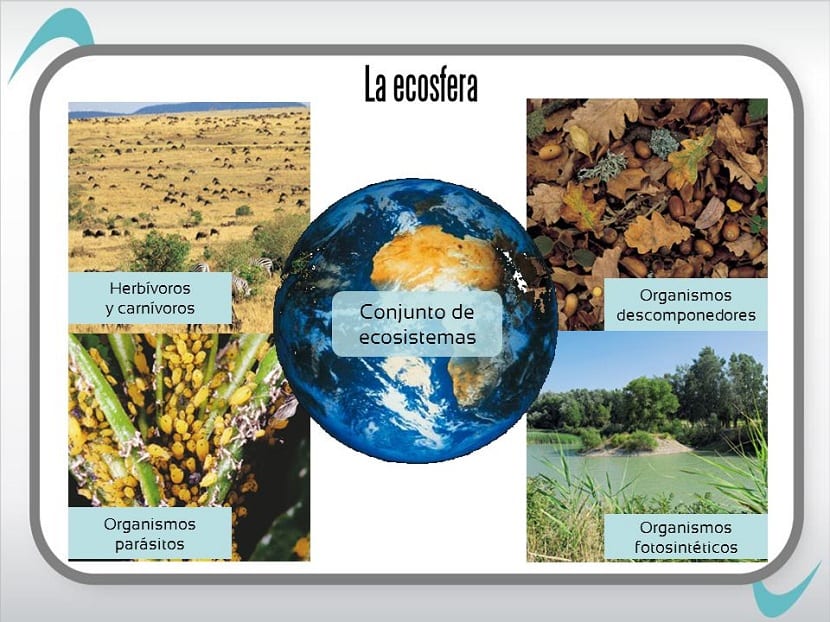
The ecosphere is composed of living (biotic) and non-living (abiotic) elements . These two categories interact through complex processes that allow life on our planet.
Biotic elements
- Producers (autotrophs): Plants, algae and certain microorganisms that generate their own food from sunlight through photosynthesis. They are the basis of all food chains on Earth.
- Consumers: Organisms that depend on other living beings for food. They are divided into:
- Primary: Herbivores that feed on plants.
- Secondary: Carnivores that feed on herbivores.
- Tertiary: Predators that hunt other carnivores.
- Decomposers: Organisms such as bacteria and fungi that break down dead organic matter, recycling essential nutrients back into the ecosystem.
Abiotic elements
- Ground: Source of nutrients for plants and home for many organisms.
- Water: Essential component for all vital processes.
- Atmosphere: It provides oxygen and regulates temperature on Earth.
- Climate: Climatic conditions directly affect plant growth and animal survival.
Differences between ecosphere and biosphere

It is crucial to understand that, while the terms ecosphere and biosphere are often used interchangeably, they are not the same. While the biosphere is limited to the specific areas of Earth where life exists, the ecosphere encompasses the interactions between living organisms and the planet's non-living elements. This broader concept includes elements such as biogeochemical cycles, which are fundamental to the maintenance of life and global ecological stability.
The ecosphere also includes processes such as the carbon cycle , the water cycle , and other cycles that are critical for the planet's environmental balance. These processes control the flow of energy and matter within the global system.
NASA's ecosphere experiment

NASA conducted an experiment that attempted to replicate the complexity of the planetary ecosphere within a closed system on a smaller scale. This experiment, known as the “crystal egg,” consisted of a hermetically sealed sphere containing seawater, shrimp, algae, and bacteria. Thanks to sunlight penetrating the sphere, the closed ecosystem remained in equilibrium for many years.
This experiment was not only relevant to the study of ecosystems, but also had important implications for the development of space missions , as it demonstrates how a closed system can sustain life without the need for external resources.
How to create a homemade ecosphere
A fun and educational way to learn more about the ecosphere and its principles of self-regulating balance is to create a homemade ecosphere . This miniature version of the ecosphere follows the same principles as the NASA experiment and is easy to make.
To get started, you'll need a glass jar, a small amount of gravel, some aquatic plants, and small invertebrates, such as shrimp or snails. By sealing the jar tightly and exposing it to indirect sunlight, you can observe how the system stays in balance. Over time, you'll understand how plants generate oxygen, animals consume this oxygen, and decomposers recycle organic matter.
This experiment shows us how delicate the balance is in the global ecosphere and provides us with a lesson in the importance of caring for the environment. As in the planetary ecosphere, small alterations in a closed system can have devastating effects on life in it.
Maintaining the balance of the global ecosphere is essential for our survival. With the increasing impact of human activity, we must be aware of the importance of sustainable strategies that help preserve this vital system for future generations.